Getting started
Install
Python ≥ 3.12. The viewers (pyglet and browser) ship with the package:
pip install coordination-oru
From a source checkout:
git clone https://github.com/jack-mcmurdo/pycoordination
cd pycoordination
pip install -e .[dev]
The web viewer's frontend ships prebuilt in PyPI wheels. In a source checkout, build it once:
npm --prefix frontend install && npm --prefix frontend run build
Run the dynamic-missions demo
coordination-oru-demo
(From a source checkout: python examples/dynamic_missions.py --web-viewer.)
This opens a browser view of three car-like robots on a 20×20 m occupancy-grid map. Click a robot, then press-drag-release on the map to post a goal pose (RViz "2D Nav Goal" style — a plain click aims the heading from the robot toward the click, Esc deselects). Each goal is planned by the built-in Hybrid A* planner and dispatched as a mission; the coordinator sequences the robots wherever their paths conflict.
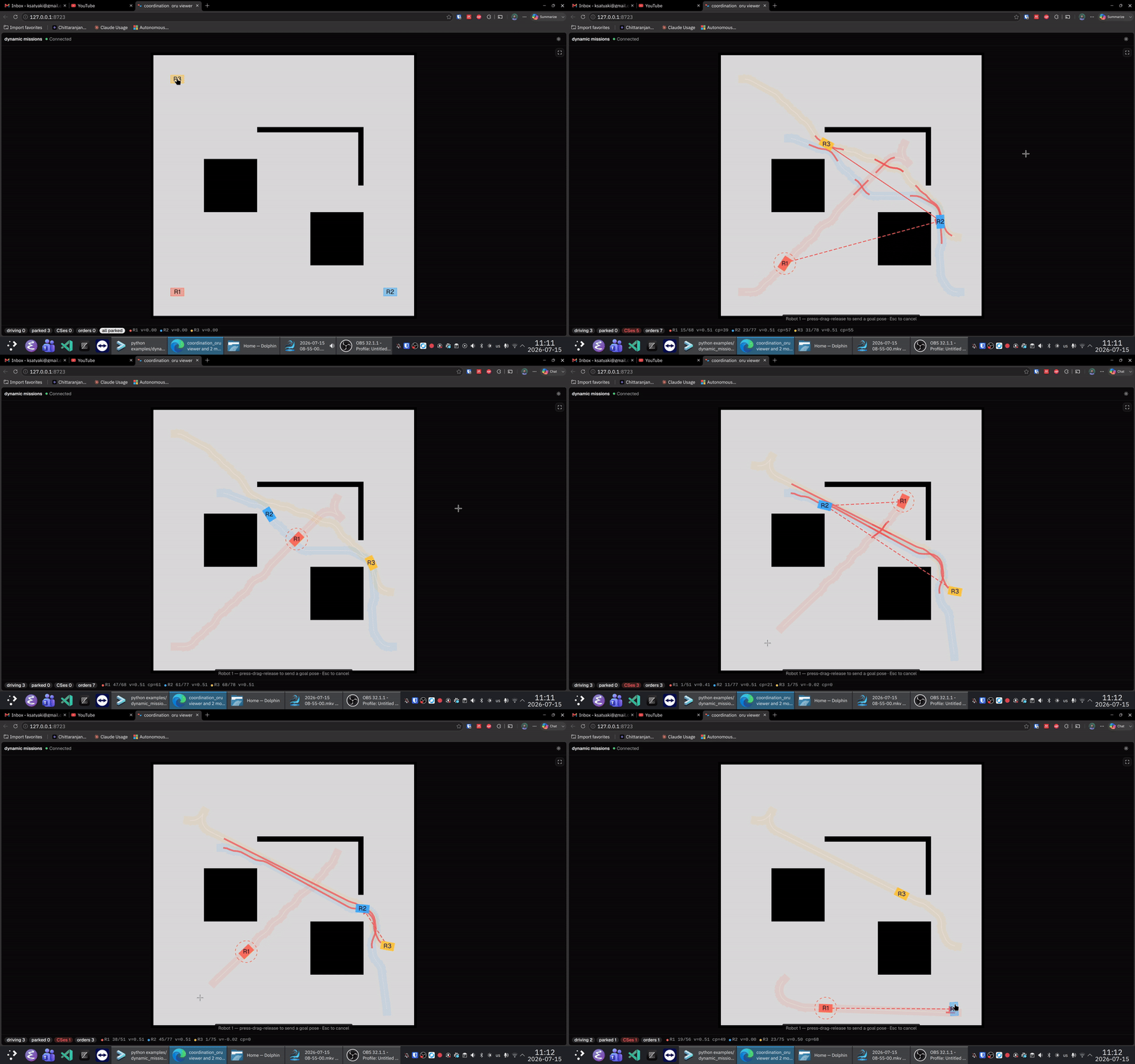
What you're seeing:
- The shaded corridor behind each robot is its trajectory envelope — the footprint swept along its path.
- Highlighted segments are critical sections: places where two envelopes overlap and the coordinator must impose an order.
- When two robots approach the same critical section, one of them slows and stops at its critical point just short of the conflict, then continues once the other robot has cleared it. No robot ever replans or deviates from its path merely to avoid another robot — coordination is purely temporal.
Other run modes
Every example accepts the same flags:
python examples/dynamic_missions.py              # scripted scenario; pyglet if installed, else headless
python examples/dynamic_missions.py --pyglet     # force the pyglet window
python examples/dynamic_missions.py --headless   # text-only, prints per-robot progress
python examples/dynamic_missions.py --web-viewer --port 9000 --no-browser
More examples in examples/:
two/three robots crossing, convoy following, five-robot sine-wave lattice,
and the original Java repo's recorded paths.
A minimal program
import asyncio
from coordination_oru import Mission, Pose
from coordination_oru.simulation2D.trajectory_envelope_coordinator_simulation import (
    TrajectoryEnvelopeCoordinatorSimulation,
)

async def main():
    tec = TrajectoryEnvelopeCoordinatorSimulation(CONTROL_PERIOD=20)
    tec.setupSolver()
    tec.setFootprint(1, (-0.5, -0.3), (-0.5, 0.3), (0.5, 0.3), (0.5, -0.3))
    tec.placeRobot(1, start_pose)          # robot 1 parked at start_pose
    await tec.startInference()             # the coordination loop (Algorithm 1)
    tec.addMissions(Mission(1, path))      # path: sequence of PoseSteering
    ...                                    # wait until parked again
    await tec.stopInference()

asyncio.run(main())
Paths can come from the built-in Hybrid A* planner, from recorded files, or from any external planner — the coordinator only cares about the sequence of poses. Next: how the theory maps to this API.